
Evidence-Led AEO Case Study Guide
Quick answer: A useful AEO case study should identify the business relationship, evidence source, date range, exact metric, work completed, and limits of the result. A prompt screenshot or crawler count without that context is not enough.
Ownership disclosure: Both examples below are operator-led. TopRatedPlaces.ai is an owned project founded and operated by Nadi Nakhle, SillyDino’s founder. Botanica is a business in which Nadi has an ownership and operating role. Neither example is presented as an independent client testimonial. Their value is the direct access SillyDino had to implementation, analytics, and evidence.
What makes AEO evidence verifiable?
SillyDino applies six questions to every case-study claim:
- Which platform or system produced the evidence?
- What exact date or reporting period does it cover?
- What is SillyDino’s relationship to the business?
- What metric appears in the original evidence?
- What conclusion can reasonably be supported?
- What cannot be concluded from that source?
This prevents crawler activity, citations, prompt results, search impressions, visits, and conversions from being merged into one inflated result.
Case study one: TopRatedPlaces.ai
Context and ownership
TopRatedPlaces.ai is a structured discovery platform founded and operated by Nadi Nakhle. SillyDino used it as an owned testing environment for search architecture, editorial guides, place profiles, internal linking, trust pages, and AI crawler accessibility.
Because SillyDino controlled the project, the team could implement and observe changes directly. The same ownership means this should be read as an internal operator case study, not independent client validation.
What was implemented
- Guides organized around specific destination and buying questions.
- Country, city, category, and place relationships.
- Structured place profiles with clear names, locations, categories, and contact paths.
- Internal links connecting related guides and entities.
- Editorial, methodology, correction, and trust information.
- Monitoring through Google Search Console and Cloudflare.
Evidence recorded
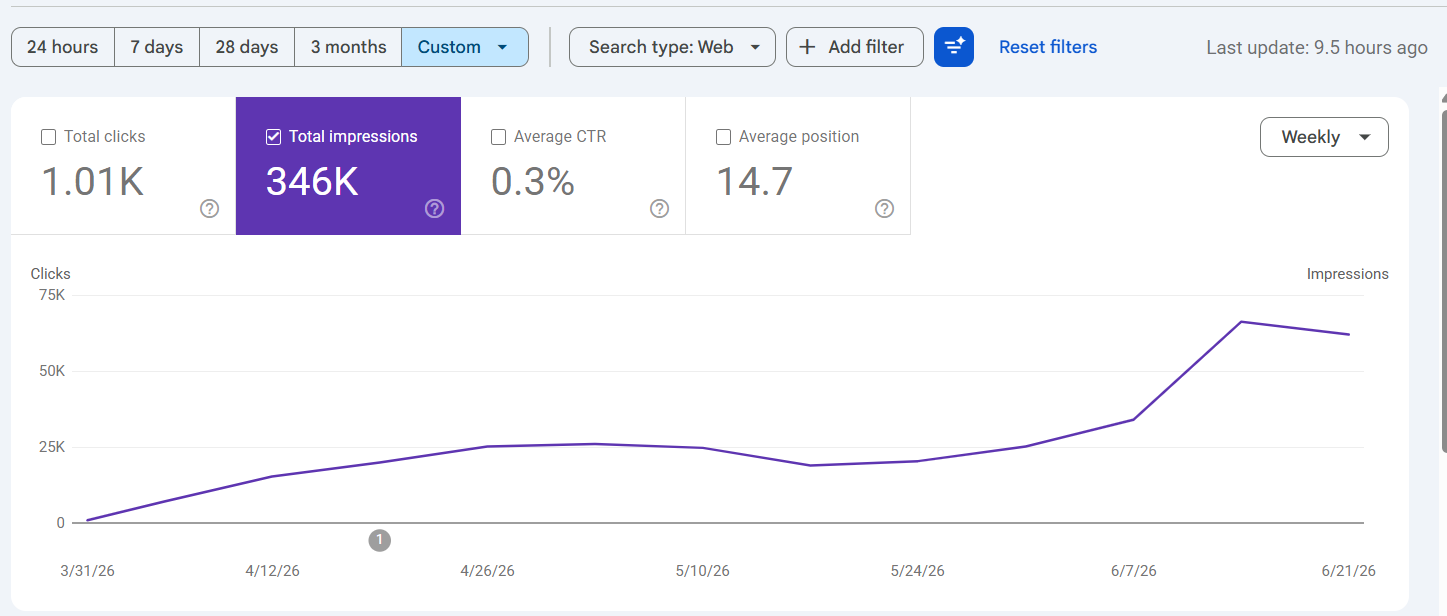
The Search Console screenshot preserved on the case-study page reports 346,000 impressions, with weekly impressions increasing from near zero to more than 66,000 during the displayed period.
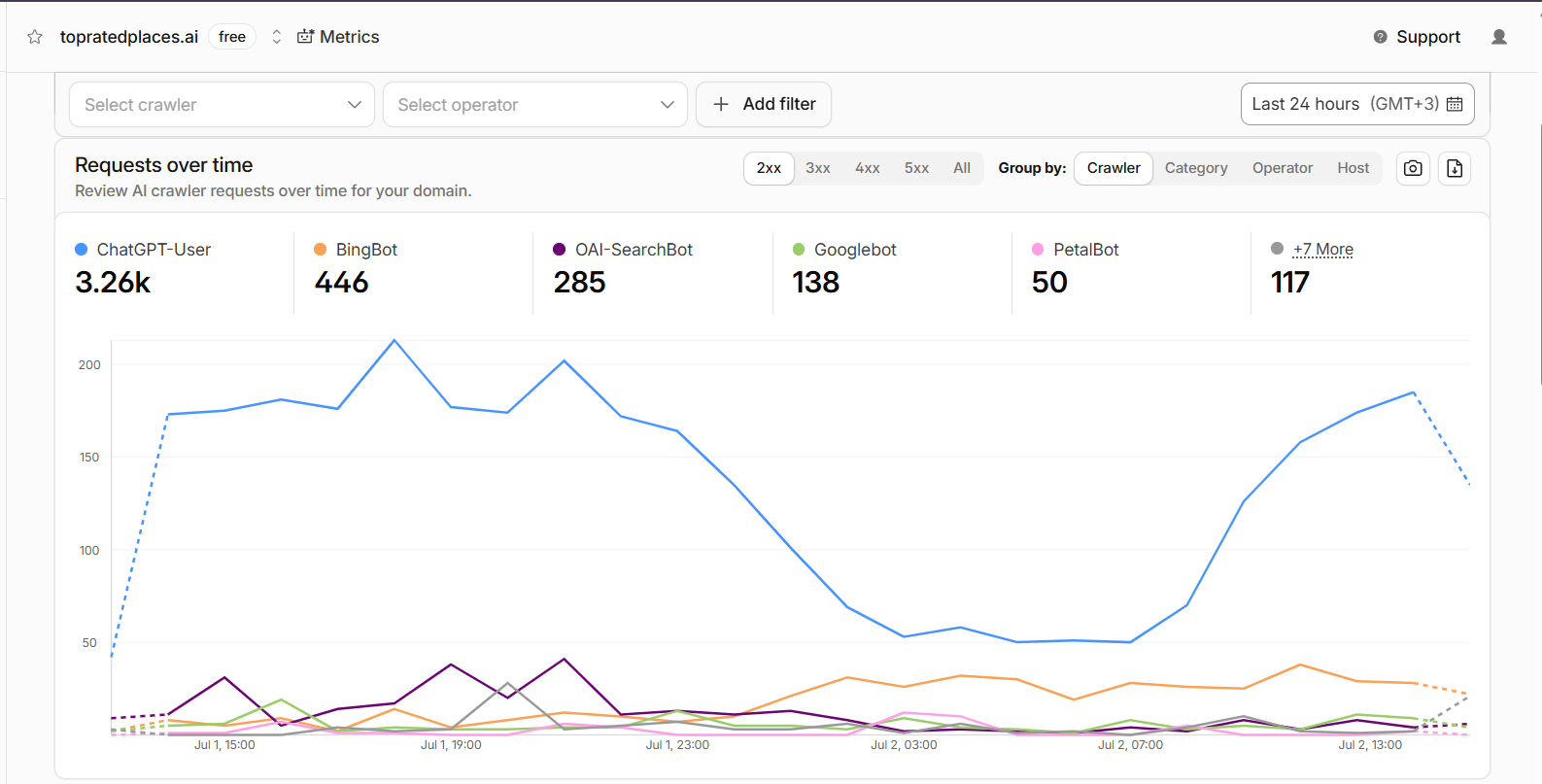
A separate Cloudflare screenshot records requests from ChatGPT-User and OAI-SearchBot during a 24-hour view.
What this evidence supports
- Google displayed TopRatedPlaces.ai pages in Search during the recorded period.
- Weekly Search impressions increased substantially during that period.
- Cloudflare received requests identified as ChatGPT-User and OAI-SearchBot.
- The site provided a practical environment for testing content structure and technical accessibility.
What it does not prove
- Crawler requests are not automatically citations, recommendations, or human visits.
- Search impressions do not prove clicks, leads, or revenue.
- An owned project does not provide independent third-party validation.
- The recorded growth does not guarantee the same result for another website.
Read the complete TopRatedPlaces.ai case study.
Case study two: Botanica
Context and ownership
Botanica is an ecommerce flower-delivery business in which SillyDino founder Nadi Nakhle has an ownership and operating role. SillyDino had direct access to the website, product structure, delivery content, search data, local visibility, analytics, and conversion paths.
This access makes the operational evidence useful, but Botanica remains a related-business example rather than an arms-length client case study.
What was implemented
- Product and collection structure based on occasions and buying intent.
- Delivery information for Lebanon, Beirut, Jounieh, and other service areas.
- Content for customers ordering flowers from abroad.
- Clear payment, delivery, contact, review, and policy signals.
- Google Search and Business Profile visibility work.
- Analytics capable of separating referral sources and ecommerce purchases.
Evidence recorded
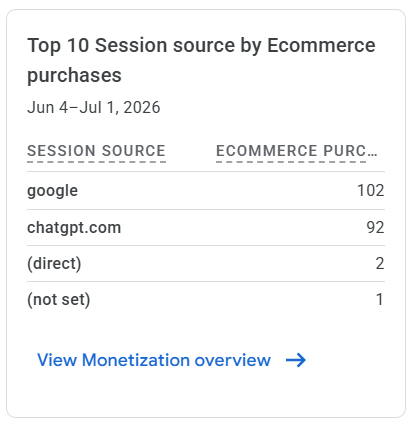
Botanica’s analytics screenshot reports 92 ecommerce purchases attributed to chatgpt.com and 102 attributed to Google from June 4 to July 1, 2026.
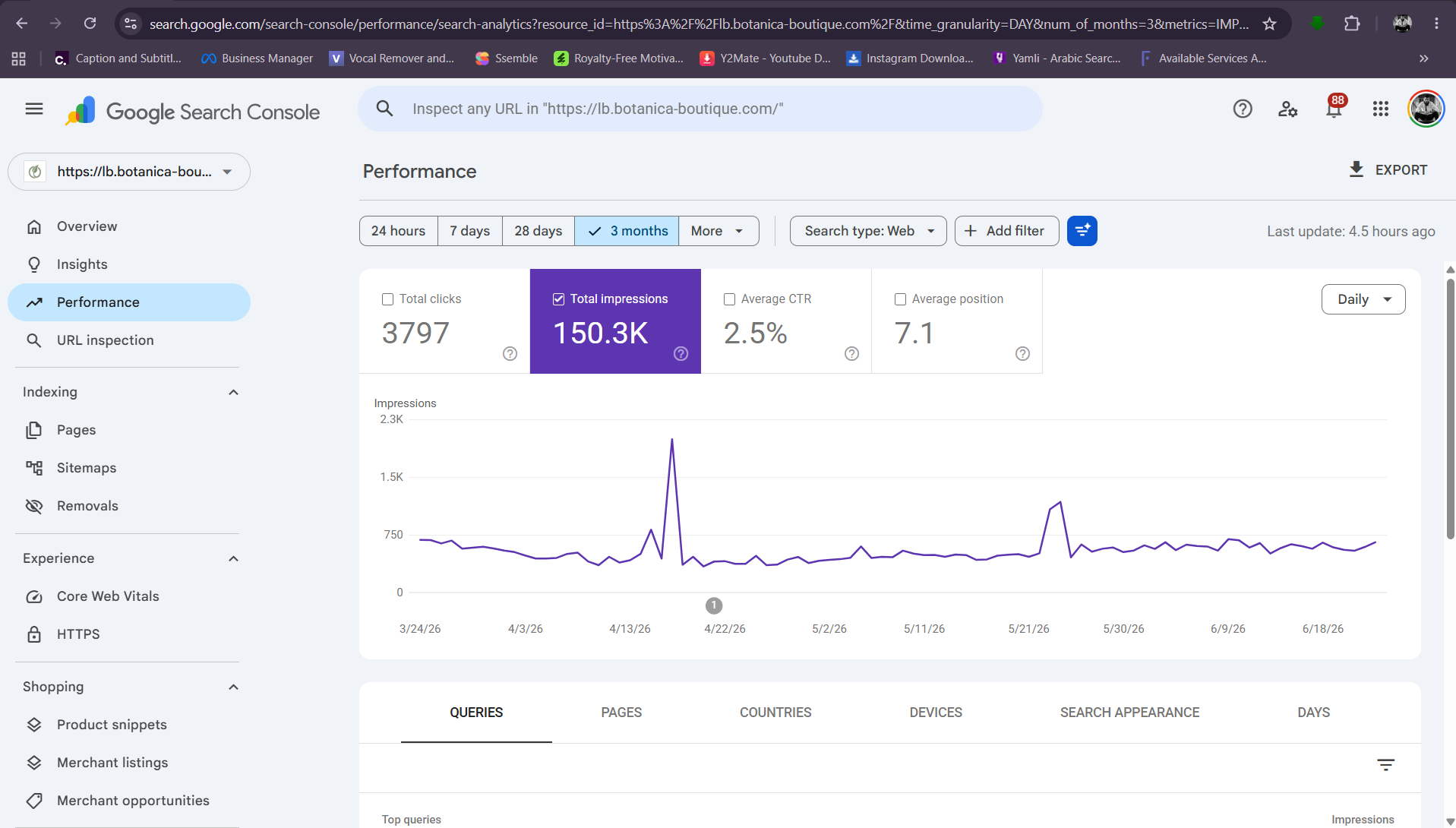
A three-month Google Search Console screenshot reports 3,797 clicks, 150,300 impressions, a 2.5 percent click-through rate, and an average position of 7.1.
Google Business Profile evidence covering January to June 2026 reports 16,559 profile views, 5,182 searches, and 1,680 interactions. Separate captures showed Botanica prominently in a Google AI Mode result and a ChatGPT answer for the displayed flower-shop questions.
What this evidence supports
- Botanica had measurable organic Search and local discovery activity.
- The website received ecommerce purchases attributed by analytics to chatgpt.com during the specified period.
- Botanica appeared prominently in the captured AI answers.
- The project connected content structure, local information, trust signals, ecommerce paths, and measurement.
What it does not prove
- The analytics view does not isolate AEO as the only cause of the purchases.
- Attribution can be affected by cookies, consent, browser behavior, referral handling, and the analytics model.
- A captured AI answer is not a permanent ranking.
- Search impressions and Business Profile activity should not be counted as purchases.
- Results from a related business are not an independent client testimonial.
Read the complete Botanica case study.
How the two examples differ
| Example | Strongest evidence | Main lesson | Main limitation |
|---|---|---|---|
| TopRatedPlaces.ai | Search Console growth and identified crawler or retrieval requests. | Clear structure and accessible pages can support discovery by Search and AI-related agents. | Requests and impressions do not automatically prove citations or commercial results. |
| Botanica | Search, local visibility, AI-answer captures, and purchases attributed to chatgpt.com. | AI discovery can become one measurable part of an ecommerce buying journey. | Analytics attribution does not prove that AEO alone caused each purchase. |
What to request from any AEO case study
- The original platform name and metric label.
- A visible date or reporting period.
- The complete screenshot or export, with sensitive customer data removed.
- The agency’s ownership or commercial relationship with the example.
- A description of the work completed before the result.
- A distinction between crawling, citations, answer appearances, referrals, and conversions.
- A statement explaining what the evidence cannot prove.
If you are evaluating providers, also review what to look for before hiring an AEO agency.
How SillyDino will document future evidence
Future case-study updates should preserve the platform, date range, evidence image, exact metric, implementation context, ownership disclosure, and limitations. When possible, SillyDino will also separate baseline, implementation date, follow-up measurement, referral traffic, and qualified business actions.
This standard supports Google’s emphasis on useful, original, experience-based content and Bing’s move toward specific AI citation reporting. It also avoids treating OpenAI crawler requests as proof of recommendation.
See all SillyDino success stories, read our results transparency policy, or request an evidence-led AI visibility snapshot.
Need a clearer starting point?
Review the evidence, ownership and limitations before choosing an AEO provider.
Results vary by market, platform, prompt, competition, source availability and implementation.